


Cubas foreign minister accused the United States of committing an “act of war” by restricting fuel shipments to the island Tuesday, prompting U.S. Ambassador to the United Nations Mike Waltz to deliver a forceful response blaming Cubas communist government for years of blackouts, repression and economic collapse.
The confrontation unfolded at the U.N. General Assembly one day after Cubas national electrical grid collapsed, leaving nearly 10 million people without power. It was the third nationwide grid failure this year and the eighth since October 2025, Reuters reported.
Cuban officials had restored electricity to parts of central Cuba and roughly one-third of Havana by Tuesday morning, although large areas remained offline or faced unstable service, according to Reuters.
CUBA PLUNGES INTO THIRD MAJOR BLACKOUT THIS YEAR AS POWER CRISIS WORSENS
Cuban Foreign Minister Bruno RodrÃguez told delegates that the Trump administration was carrying out a “multidimensional, non-conventional war” against Cuba that had grown “more cruel and ruthless in the last seven months.”
RodrÃguez described U.S. efforts to restrict fuel deliveries as the imposition of “an energy collapse, equivalent to a naval blockade, which is an act of war,” according to a UNTV transcript.
Waltz rejected the claim that the United States had established a naval blockade around Cuba.
“There is no ring of Navy warships, U.S. Navy warships sitting around this island blocking trade or humanitarian aid going into Cuba,” Waltz said. “Its fake. Its false. Its a lie. Period.”
Waltz argued that the real embargo was the one Cubas government imposed on its own citizens.
HAVANA REGIME IN SUSPENSE AFTER CASTRO INDICTMENT WITH TRUMP PRESSURE ON, SAYS CUBAN-BORN GOP REP.
“Theres a lot of talk today of an embargo. And indeed there is one,” he said. “Its the embargo the Cuban regime mercilessly imposes on its own people decade after decade after decade.”
He called on Havana to “change your ways” and “turn the lights back on for your people,” while accusing Cubas leaders of ensuring that government compounds and propaganda operations had power even as families worried about spoiled food, hospitals losing electricity and phones running out of charge.
Waltz noted that Tuesdays meeting came days before the fifth anniversary of the July 11, 2021, demonstrations, when thousands of Cubans took to the streets amid shortages of food, medicine and electricity and demanded greater freedom.
As Waltz spoke, a member of the Cuban delegation pounded on the table, prompting the ambassador to respond.
“This is not Havana. This is the United States of America. This is the United Nations,” Waltz said. “And we will speak, we will be heard, and we will not be silenced like your own people. So, pound away.”
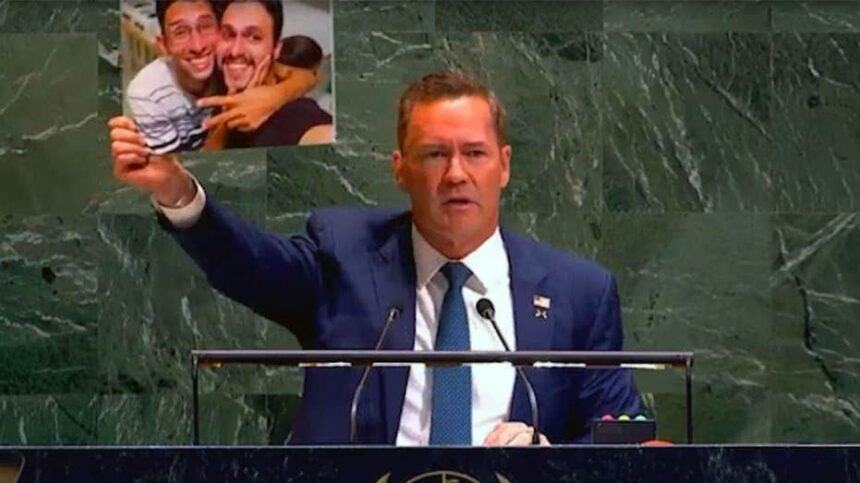
Waltz displayed photographs and read the names of several jailed Cuban artists, musicians and activists, including Luis Manuel Otero Alcántara, Maykel Castillo Pérez and Duannis Dabel León Taboada.
“Theyre not armed. Theyre not violent,” Waltz said. “They carry flowers, and write poems and write music. And for that, the regime beats them, detains t


