


A bipartisan housing bill became law Saturday at midnight after President declined to sign it, capping a weeks-long saga over whether the president would veto the measure amid frustrations with Congress over his stalled agenda.
Trump refused to sign the 21st Century ROAD to Housing Act â legislation aimed at expanding the nations housing stock and lowering costs â in an attempt to pressure Congress to pass the SAVE America Act, despite the housing bill clearing both chambers with overwhelming majorities.
“I will not sign the Housing Bill, which has been fully approved by Congress and sent to the White House, in PROTEST over the fact that the United States Senate is not capable of passing THE SAVE AMERICA ACT, which is polling at 97% with the Republican Party, and very high with the non-politician Dumocrats,” he declared on Truth Social Friday morning.Â
The Trump-backed election measure, which would require proof of citizenship to vote in federal elections and impose voter ID requirements, has struggled to overcome the Senates 60-vote threshold.Â
Meanwhile, the House has not passed a version of the bill that includes the presidents proposed crackdown on mail-in voting and banning men from womens sports.
HOUSE CONSERVATIVES DERAIL GOP AGENDA IN SAVE AMERICA ACT SHOWDOWN
Under the U.S. Constitution, Trump had 10 days, not including Sundays, to sign or veto the housing measure after the House formally transmitted the legislation to the in late June. The president ultimately chose neither option, allowing the measure to become law without his signature.
Though Trump declined to veto the legislation, he sharply criticized elements of the bill and argued it should not have been a legislative priority in recent weeks.
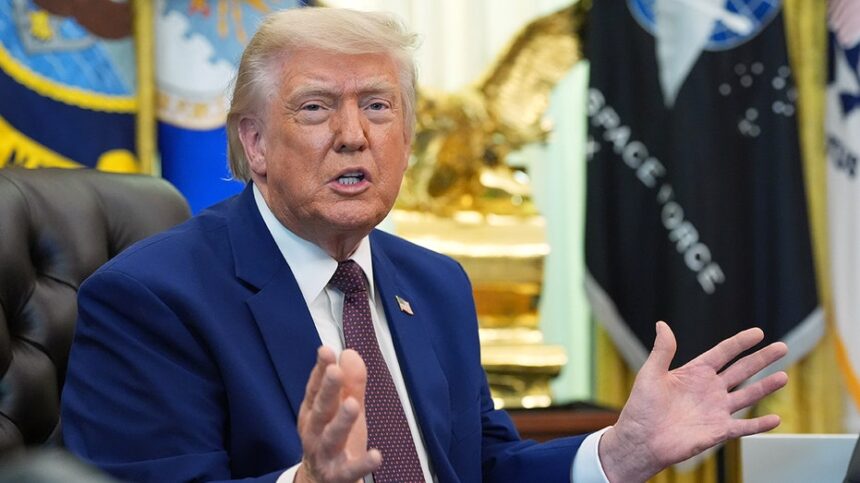
“It’s so unimportant ⦠compared to the SAVE America Act,” Trump told reporters in the Oval Office in late June. “I think the SAVE America Act is exactly what it says. It’s saving America from crooked elections.”
Trump went on to call the housing bill “a yawn,” adding, “compared to the SAVE America Act, just about everything is a big yawn.”
It would have taken a two-thirds majority in both chambers to override a veto â a margin the House and Senate exceeded when they passed the legislation. However, it remains unclear whether so many Republicans would have defied the president had he vetoed the bill.
Trump also appeared to criticize the bill over a provision restricting Wall Street investors from purchasing single-family homes â a policy he first proposed during his January State of the Union address and later urged Congress to pass. Trump previously argued the investor ban would give individual homebuyers a leg up against private equity firms in the housing market.
“I don’t want to hurt people that own houses, too,” Trump later told reporters, appearing to reference the provision. “These people, for the first time in their lives, they have valuable houses. They’ve become rich. I don’t want to hurt them either. What you want to do is what’s good for everyone, get the interest rates down.”
The law also aims to boost housing supply by streamlining federal environmental reviews, loosening rules around the construction of factory-built homes, and incentivizing local governments to modify their zoning laws to allow more housing, among roughly 60 provisions.
Trumps souring on the legislation created headaches for Republicans, who touted the bill as an affordability win as voters grapple with high housing costs.
“Its irrespon


