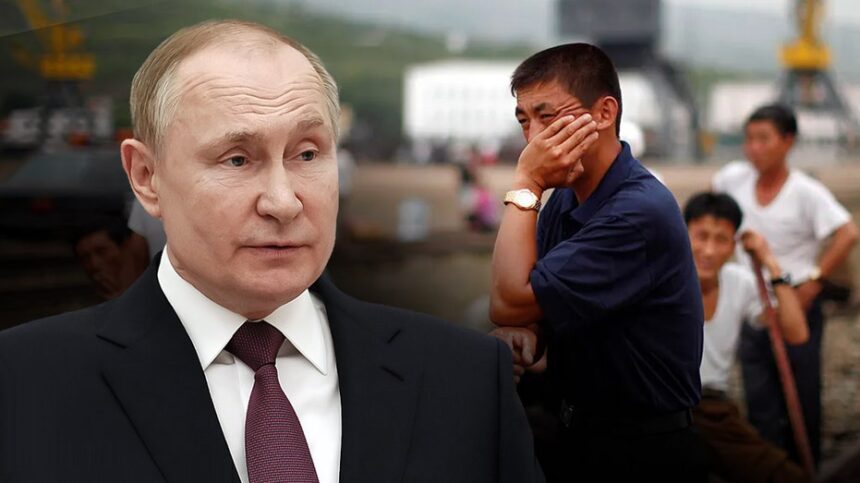
 “Wake up before 6 a.m. to the Russian winter. Walk to the construction site as a group. Work from 7 a.m. until 10, 11 p.m., sometimes even midnight. Without breaks. There is no set end time. You finish when the target is met. Rain, snow, it does not matter. We worked with no gloves, no heating, no protective equipment. My hands cracked so badly I could not grip the tools. But you do not stop.”
This was the reality for “RT,” identified by his initials to protect his identity, a former reported victim of North Korea’s , who described his experience to Fox News Digital.Â
The man was one of the 100,000 workers sent overseas under North Koreas state-sponsored labor program.
“I was told I could earn money,” he claimed to Fox News Digital. “That was all. Nobody mentioned a quota. Nobody told me that most of what I earn would be taken. I thought if I went to Russia and worked hard, I could save enough to build a better life for my family. When I arrived, I realized none of that was true. The money was not mine. It was never going to be mine.”
A new report published by the international human rights organization Global Rights Compliance shares firsthand testimonies from North Koreans working in Russia.
The report found that Russian companies are employing North Korean workers in violation of United Nations sanctions, often obscuring their identities so laborers do not even know who they are working for. U.N. Security Council resolutions require member states to repatriate North Korean workers, making their continued presence in Russia a potential breach of international sanctions.
The findings offer one of the clearest pictures yet of how North Korea is allegedly sustaining its regime under sanctions: exporting its citizens as labor, extracting their wages, and maintaining total control even beyond its borders.
Global Rights Compliance North Korea advisor Yeji Kim told Fox News Digital, “Every North Korean worker deployed abroad must pay a mandatory monthly sum to the state, known as the gukga gyehoekbun. As one worker told us, it must be paid no matter what, dead or alive.”
A typical worker earns roughly $800 a month for up to 420 hours of labor. From that, between $600 and $850 is deducted for the quota, along with additional payments for travel debt and communal living expenses, Kim said.Â
What remains is approximately $10. If workers fall short, the deficit carries forward, leaving some in debt for an entire year, according to Kim.Â
One worker described the quota as a “lump on his back” that dictated every aspect of his life abroad.
“Every month you must pay,” RT claimed. “There is no negotiation. If you fall short, the debt carries forward to the next month. We were told, The quota must be met by any means necessary, even if it meant paying out of their own pocket. You came to earn and you leave with nothing. And if you fail too many times, they send you home. Home does not mean relief. It means blacklisting, interrogation, and sometimes your family paying the price.”
Fox News Digital reached out to the Russian Ministry of Foreign Affairs and North Koreas mission to the United Nations for comment and did not receive a response in time for publication.
The report identified what it said are all 11 International Labour Organization indicators of forced labor across 21 testimonies from workers in who did not know each other. These include debt bondage, restriction of movement, withholding of wages, excessive overtime, physical violence, surveillance, deception, isolation, abuse of vulnerability and abusive conditions.
Upon arrival in Russia, passports are immediately confiscated and retained by North Korean security officials, according to the report.Â
“My passport was taken the day I arrived,” RT said. “I never held it again. I could not leave the worksite freely. The city was right there, beyond the fence, but we were sea